
Not many mediums, including video games, dabble with mental illness. Even fewer are able to string together a narrative that has it front and centre. If a video game decides to play with the concept madness, it’s often used as a gameplay mechanic to heighten the tension (I’m looking at you Cthulhu!). Usually by adding a sanity gauge that will force the player to juggle between finding ways to reduce it or to slog on as the HUD changes/ control quirks are implemented when the main character is overwhelmed by all the fish people they see or the great unknowable squid face monster in the distance. Hellblade: Senua’s Sacrifice, however, is one of those rare gems of a game that actually explores mental illness – in particular, psychosis – in a meaningful way from both a narrative and gameplay perspective in order to tell a gripping story of loss and grief.

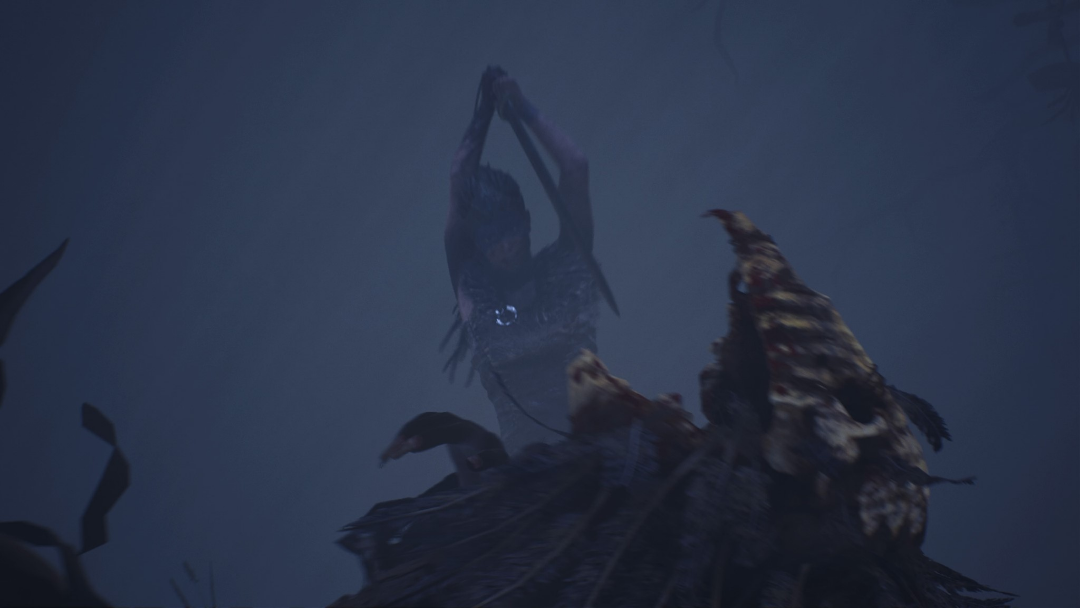
Hellblade: Senua’s Sacrifice puts players into the skin of a Pict warrior called Senua. She is on a journey into Helheim in a last desperate bid to rescue her dead love Dillion. As the game unfolds, we find out more about her life and the events leading up to her quest. Accompanying both the player and Senua on this adventure are a host of disembodied voices. Some of them are helpful, particularly in combat as they provide warnings when enemies attack. Others serve to pull Senua down, questioning her every move and action.
It was a strange experience to have these voices providing a running commentary as I made my way through the game. I will admit that I knew some of the voices intimately. They being part of my own internal dialogue.
I know it would have better served me to strap on a pair of headphones, but I still found it fascinating to have these voices whisper from my television as I delved deeper into Senua’s story.
One important thing I managed to grasp from the game was that our perception of the world differs. A person might think in sentences and words, yet another would do so through a visual spectrum. Synesthesia is a condition where people can see words as specific colours. Someone else could be colour-blind. Those with imagination might see more than a fluffy white cloud or faces in even the simplest of pattern configurations.
With Senua, though, her psychosis allows her to see hallucinations, to endure flashbacks and to see strange runic symbols in the world around her. But even though what she sees might be different from what someone else experiences does not discount the world she lives in or her perception of it. As gamers, particularly, we often internalise the limitations and rules of the game world in order to proceed. To open a door, we intuitively know that we need a key. That key, however, could be a set of runes. It could be a switch. Or perhaps it might be a secret incantation or pass phrase.
As such, I found Hellblade: Senua’s Sacrifice an empowering experience that helped challenge how I saw the world around me. All of us contain a strange set of beliefs even if it makes no sense. Take superstitions for example. Why should a black cat crossing your path constitute bad luck?
In any case, Hellblade: Senua’s Sacrifice immediately had me invested with its delightful anecdotes of Norse mythology. Long time readers will know that I’ve always been a fan of myths and any game featuring them have always tickled my interest.
The combat, too, was serviceable. Strangely enough, I found that I played much more defensively than I usually did in such games as parrying proved to be quite an important facet of quickly taking down opponents. While I usually prefer dodging, the camera feels a little constrained. For those that decide to pick up the title, make sure that any any all enemies are in front of you and keep your back to the wall so that they won’t target you from behind.
I will admit, though, that it took me a while to pick up the game. For a while after it was released, I had read that the game would delete your save if you died too many times. This was made manifest by the rot travelling along Senua’s arm. As someone who has avoided difficult games such as Dark Souls, this made me hesitant to try it on until I learned that this too was a ploy by the developers. One should not always believe the things that appear before their eyes. Doubly so when it comes to video games and the way they play with expectations.
Overall, Senua’s Sacrifice was a great side morsel and one that I had my eye on for quite a while. Hopefully there are more games that come out that put a stronger focus on mental illness. Video games, in particular, are such a great medium to explore these themes because of their interactive nature.


 The Writing Corner